Launch offer — valid today only

📄 Digital book in PDF · read it on your phone or print it

The EKG Tech Exam in Drawings: Place All 10 Electrodes and Read Every Strip in the Same 5 Steps One Topic on Every Page

The conduction path, V1 to V6 on the body, limb colors, patient prep, artifacts, the three rate methods, atrial fibrillation, heart blocks and Holter. Every topic gets its own page: the drawing first, then what you need to remember. 66 illustrated pages.

I WANT THE EKG EXAM IN DRAWINGS

🔒 Secure checkout · PDF by email · 30-day guarantee

Every topic, its own pageEach lead, rhythm and artifact drawn, with the explanation right beside it
66 illustrated pages9 parts, from the heart's wiring to the exam-day review
Up-to-date sourcesChecked against the current NHA CET exam test plan and current American Heart Association references
PDF by emailFormat

Look Inside the Book

Every page has one big drawing and a box with the numbers, landmarks and steps you need to know:

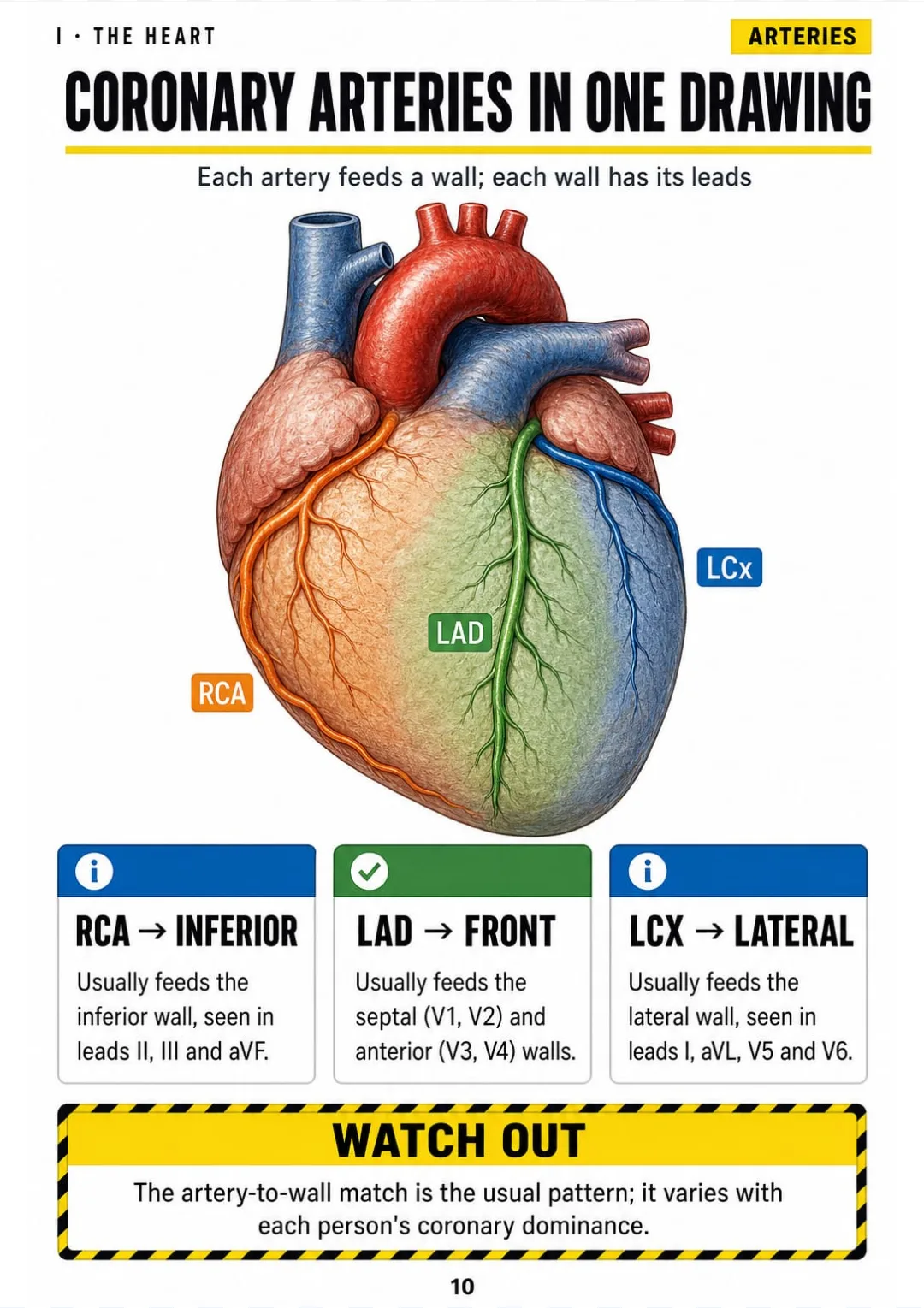
RCA → inferior (II, III, aVF) · LAD → septal/anterior (V1–V4) · LCx → lateral
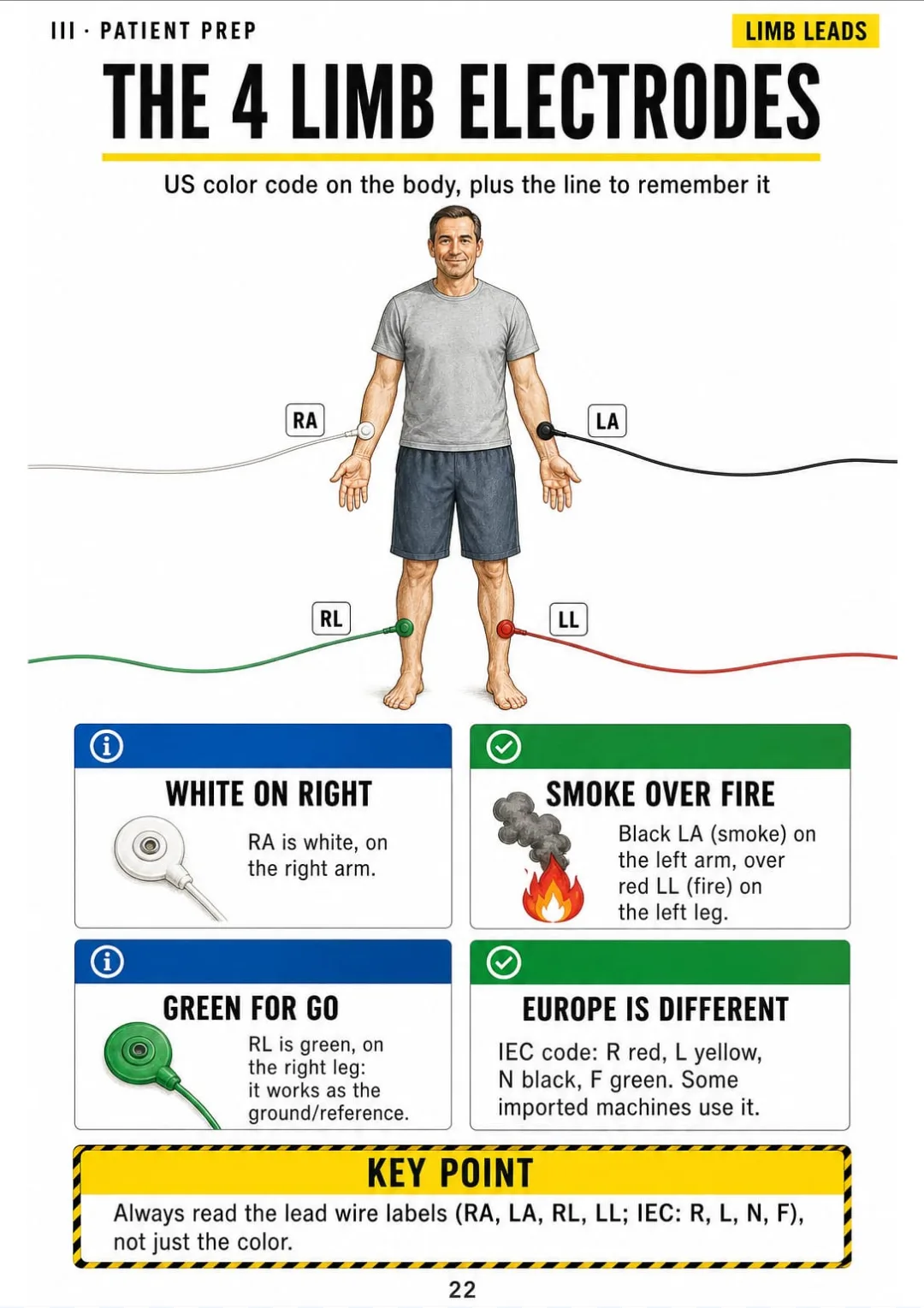
US limb colors: RA white, LA black, RL green, LL red; IEC uses a different code
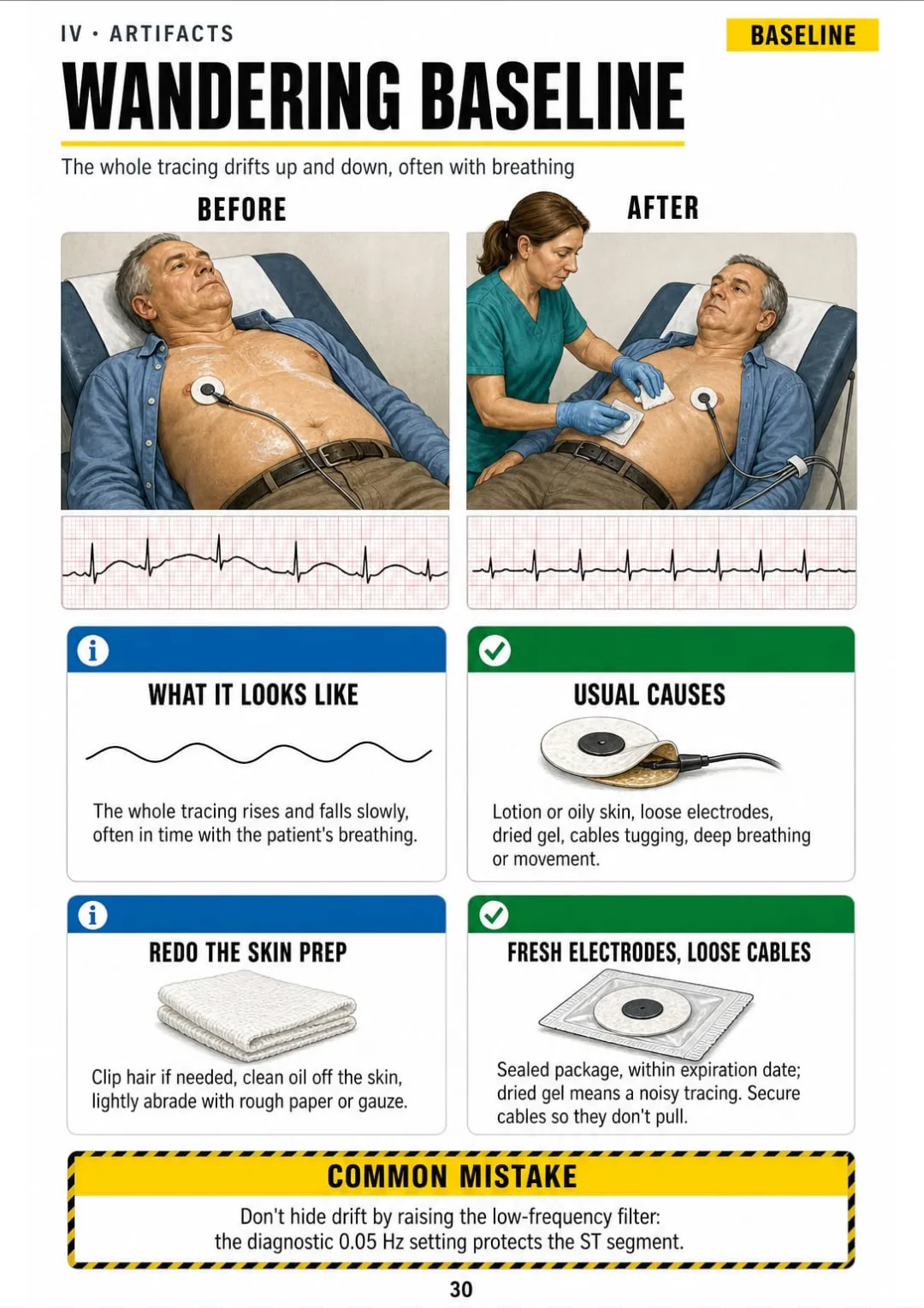
Wandering baseline: slow drift from lotion, loose electrodes or breathing; fix the prep and secure the cables.
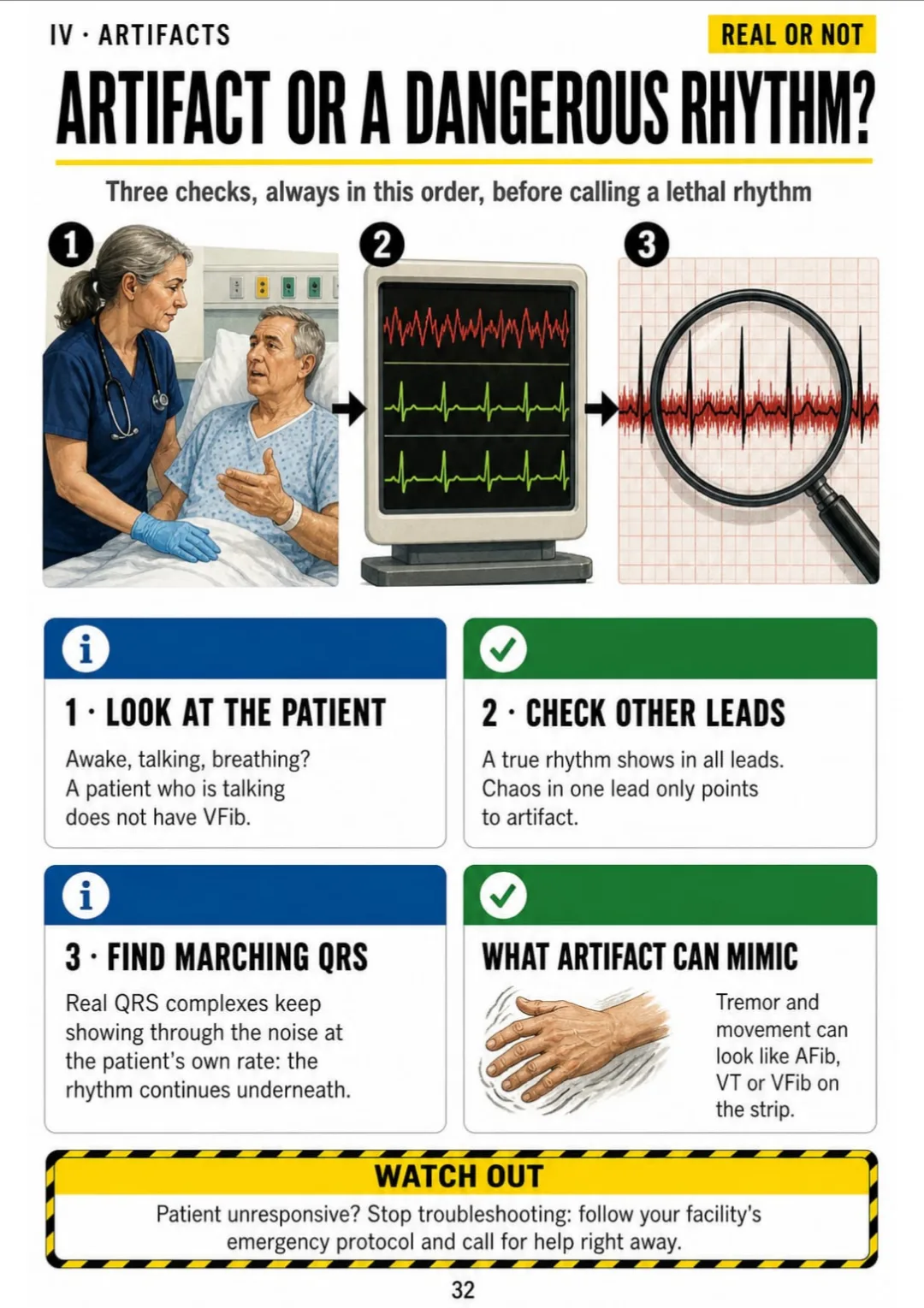
Artifact or lethal rhythm: look at the patient, check other leads, find QRS marching through the noise.
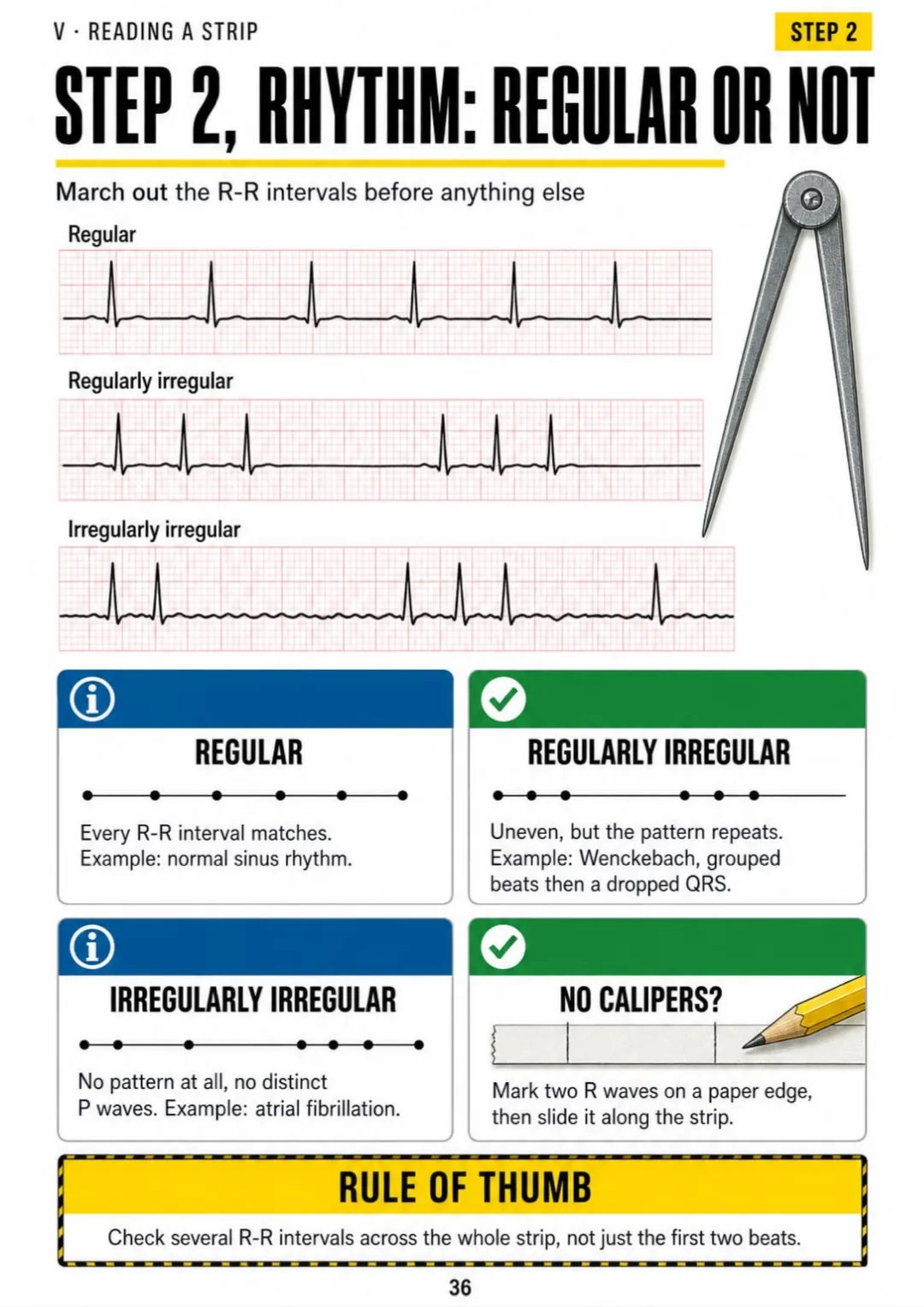
March out R-R intervals: regular, regularly irregular, irregularly irregular
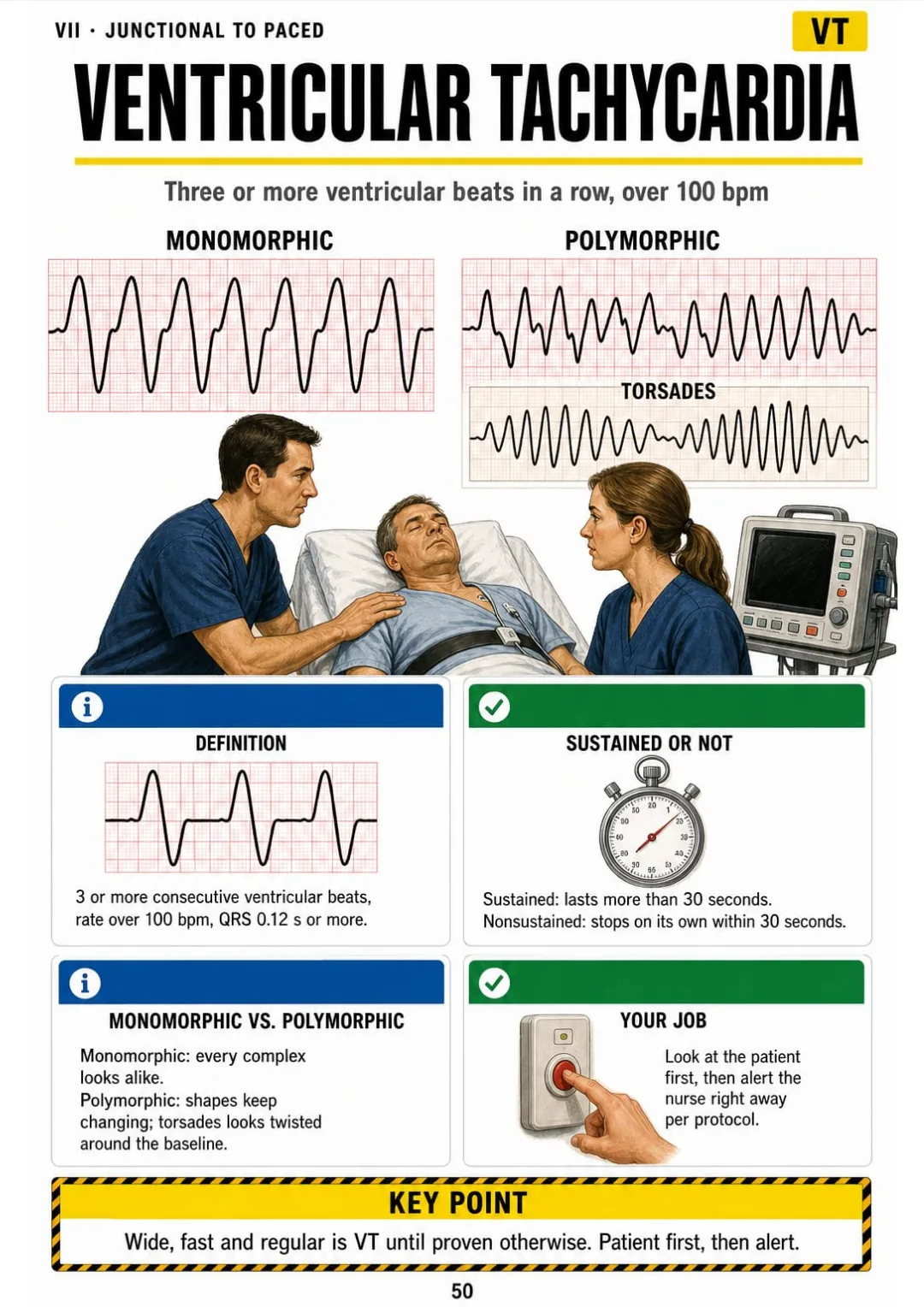
VT: 3+ ventricular beats in a row, over 100 bpm, QRS 0.12 s or more · sustained = over 30 s
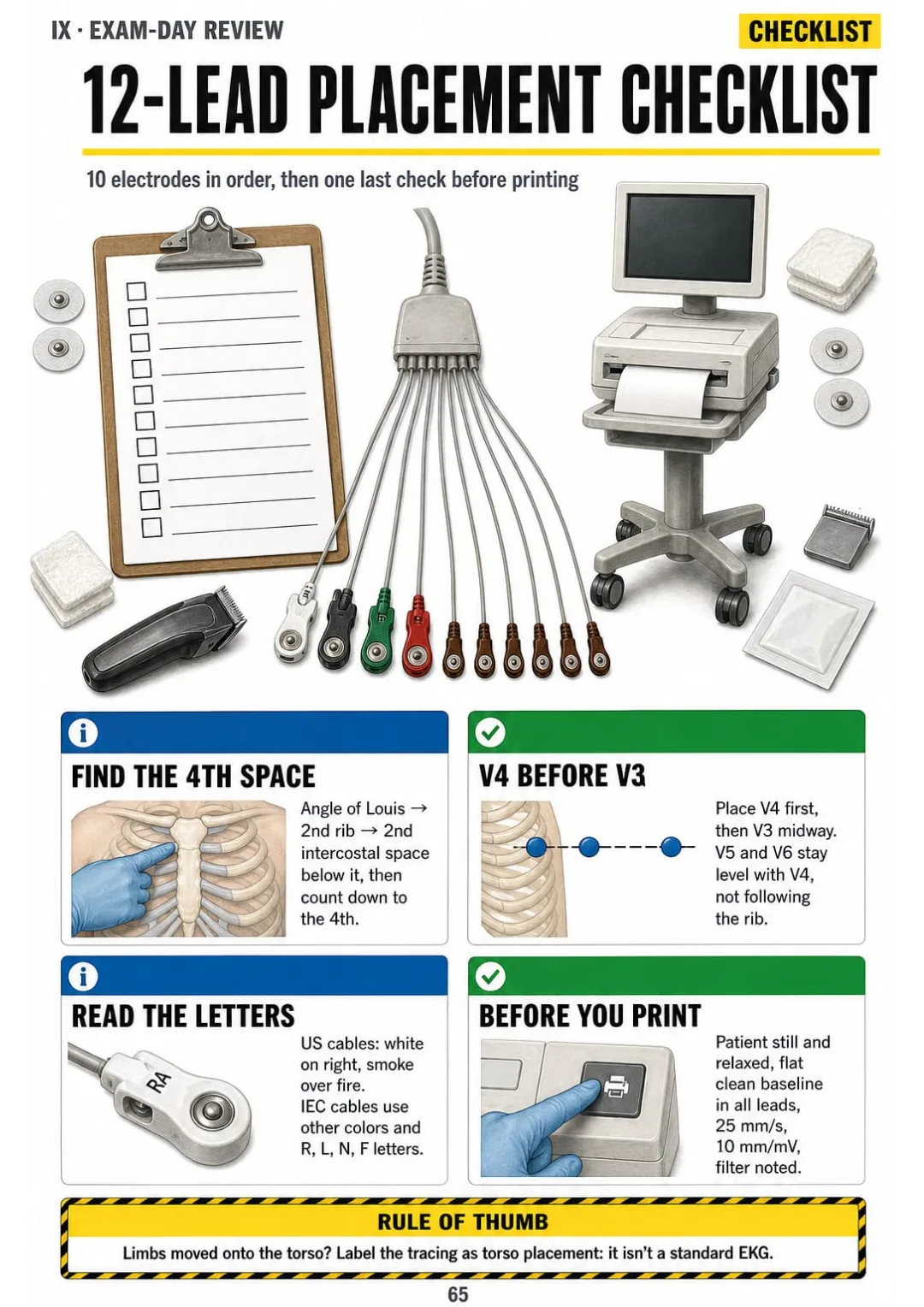
10 electrodes ticked off in order with landmarks and colors, plus the last check

Swipe to see more →

These are real pages from the book. The table of contents is the full one: 9 parts and 62 topics.

The Problem Isn't You. It's How It Was Explained to You.

You're running a strip on the floor and the screen fills with chaotic squiggles. It looks like V-fib. But the patient is sitting up and talking to you.

Your textbook covers this in three dense paragraphs on tremor, interference and lead problems. Under pressure, paragraphs don't come back to you. So you freeze: call the nurse, or check a lead?

Wandering baseline: slow drift from lotion, loose electrodes or breathing; fix the prep and secure the cables.

In this book it's one page. The noisy strip is drawn, with three checks next to it: look at the patient, check the other leads, find the QRS marching through the noise.

The rest works the same way: limb lead reversal, the three rate methods, Wenckebach, V1 to V6 on the chest, the limb colors. Each one has its own page.

You see it, you get it, and the next time you can tell an artifact from a rhythm without opening the manual.

COMPARE FOR YOURSELF

Same Topic, Two Ways to Study It

THIS
  • The manual: line after line after line
  • Electrode placement explained only in words
  • You walk into the exam still unsure
Limb electrodes are applied to the extremities to obtain the frontal plane leads. In the United States, the AHA color convention applies, whereby the right arm electrode is white, the left arm electrode is black, the right leg electrode is green and the left leg electrode is red, whereas the IEC convention, used in other regions, assigns a different color code to each position. Electrodes should be placed on fleshy surfaces, avoiding bony prominences, and symmetrical placement on both limbs is required to prevent distortion of the recorded waveforms.
FOR THIS
  • The 4 limb electrodes on one body drawing
  • The colors and landmarks in a box
  • You see it and you get it
US limb colors: RA white, LA black, RL green, LL red; IEC uses a different code
CONTENTS

Take a Look at the 9 Parts and 62 Topics

The heart's wiring, the paper and the waves, patient prep and the 12 leads, artifacts, reading a strip in 5 steps, sinus and atrial rhythms, junctional, ventricular, blocks and paced rhythms, stress testing and Holter, and the exam-day review: 66 pages, all illustrated.

IThe Heart and Its Wiring · pp. 5-11
  1. Four chambers, one direction of flow
  2. The conduction path, start to finish
  3. Each pacemaker has its own speed
  4. Depolarization vs. repolarization
  5. Where the AV node pauses, and why it matters
  6. Coronary arteries in one drawing
  7. Heart words the exam uses
IIThe Paper and the Waves · pp. 12-18
  1. The grid: small box, big box
  2. Calibration: the 10 mm pulse
  3. P, QRS, T, and sometimes U
  4. The PR interval: 0.12 to 0.20 seconds
  5. The QRS: under 0.12 seconds
  6. ST segment and QT interval
  7. Naming Q, R and S correctly
IIIPatient Prep and the 12 Leads · pp. 19-27
  1. Before you touch the patient
  2. Positioning the patient
  3. Skin prep that keeps the tracing clean
  4. The 4 limb electrodes and their colors
  5. V1 and V2: the fourth intercostal space
  6. V4, then V3, then V5 and V6
  7. 12 leads from 10 electrodes
  8. Which leads look at which wall
  9. Special cases: breasts, amputations, kids
IVArtifacts and Troubleshooting · pp. 28-33
  1. Somatic tremor: the shaky baseline
  2. 60-cycle (AC) interference
  3. Wandering baseline
  4. Loose or broken lead
  5. Artifact or a dangerous rhythm?
  6. Limb lead reversal on the tracing
VReading a Strip in 5 Steps · pp. 34-39
  1. The 5 steps, always in this order
  2. Step 1, rate: three methods
  3. Step 2, rhythm: regular or not
  4. Step 3, P wave: the five questions
  5. Steps 4 and 5: PR and QRS in boxes
  6. Practice run: one strip, five answers
VISinus and Atrial Rhythms · pp. 40-47
  1. Normal sinus rhythm
  2. Sinus bradycardia and sinus tachycardia
  3. Sinus arrhythmia
  4. Sinus pause vs. sinus arrest
  5. Premature atrial contractions (PACs)
  6. Atrial flutter: the sawtooth
  7. Atrial fibrillation: irregularly irregular
  8. SVT: fast, narrow, regular
VIIJunctional, Ventricular, Blocks and Paced · pp. 48-57
  1. Junctional rhythms: P upside down or missing
  2. PVCs: wide, early, bizarre
  3. Ventricular tachycardia
  4. Ventricular fibrillation and asystole
  5. Idioventricular rhythm
  6. The block ladder: first degree
  7. Second degree type I (Wenckebach)
  8. Second degree type II
  9. Third degree: P and QRS go their own way
  10. Paced rhythms and failure to capture
VIIIStress Testing, Holter and Safety · pp. 58-62
  1. Stress test: the tech's role
  2. When a stress test stops
  3. Holter and event monitors
  4. Telemetry: watching the screen
  5. Safety, privacy and the record
IXExam-Day Review · pp. 63-66
  1. Every rhythm on one grid
  2. Numbers to have at your fingertips
  3. 12-lead placement checklist
  4. Mistakes seen most often, and the fix

One Page, One Topic, All Clear

Think of it this way:

The nurse hands you an order for a 12-lead. The patient is on the bed with the gown open, and you need V1 to V6 in the right spot on the first try.

You open the book to the chest page and there's the body outline: V1 and V2 at the fourth intercostal space on either side of the sternum, V4 at the fifth space on the midclavicular line, V3 halfway between V2 and V4, then V5 and V6 level with V4.

March out R-R intervals: regular, regularly irregular, irregularly irregular

Same with the limb colors, 60-cycle interference, the PR interval, atrial flutter and third-degree block: each one on its own page.

EKG Technician Exam Illustrated has 9 parts and 62 topics, all drawn, and it ends with an exam-day review that puts every rhythm on one grid.

What you see drawn, you don't have to memorize.

What's Inside EKG Technician Exam Illustrated:

Ipp. 5-11

The Heart and Its Wiring

The four chambers and blood flow, the conduction path, each pacemaker's speed, depolarization and repolarization, the AV node pause, the coronary arteries and the heart terms the exam uses.

IIpp. 12-18

The Paper and the Waves

The grid with small and big boxes, the 10 mm calibration square, P, QRS, T and U, the normal PR and QRS, the ST segment and QT, and naming Q, R and S correctly.

IIIpp. 19-27

Patient Prep and the 12 Leads

What to do before you touch the patient, positioning, skin prep, the limb colors, V1 to V6 with their landmarks, 12 leads from 10 electrodes, which leads look at which wall, and special cases.

IVpp. 28-33

Artifacts and Troubleshooting

Somatic tremor, 60-cycle interference, wandering baseline, loose leads and limb lead reversal on the tracing, so you can tell a noisy strip from a dangerous rhythm before you call anyone.

Vpp. 34-39

Reading a Strip in 5 Steps

The 5 steps in the same order on every strip: three rate methods and when each one fits, regular or not, the P wave questions, PR and QRS in boxes, and a full practice run, so you always know where to start.

VIpp. 40-47

Sinus and Atrial Rhythms

Normal sinus rhythm, sinus brady and tachy, sinus arrhythmia, pause vs. arrest, PACs, flutter, A-fib and SVT.

VIIpp. 48-57

Junctional, Ventricular, Blocks and Paced

Junctional rhythms, PVCs, V-tach, V-fib and asystole, idioventricular rhythm, the block ladder from first to third degree, and paced rhythms with failure to capture.

VIIIpp. 58-62

Stress Testing, Holter and Safety

The tech's role in a stress test, when the test stops, Holter and event monitors, telemetry, and safety and privacy.

IXpp. 63-66

Exam-Day Review

Every rhythm on one grid, the numbers to keep at your fingertips, the 12-lead checklist and the most frequent mistakes with their fix.

At the end of the book: An exam-day review with every rhythm on one grid, the key numbers and a 12-lead placement checklist.
Plus: 2 Free Books

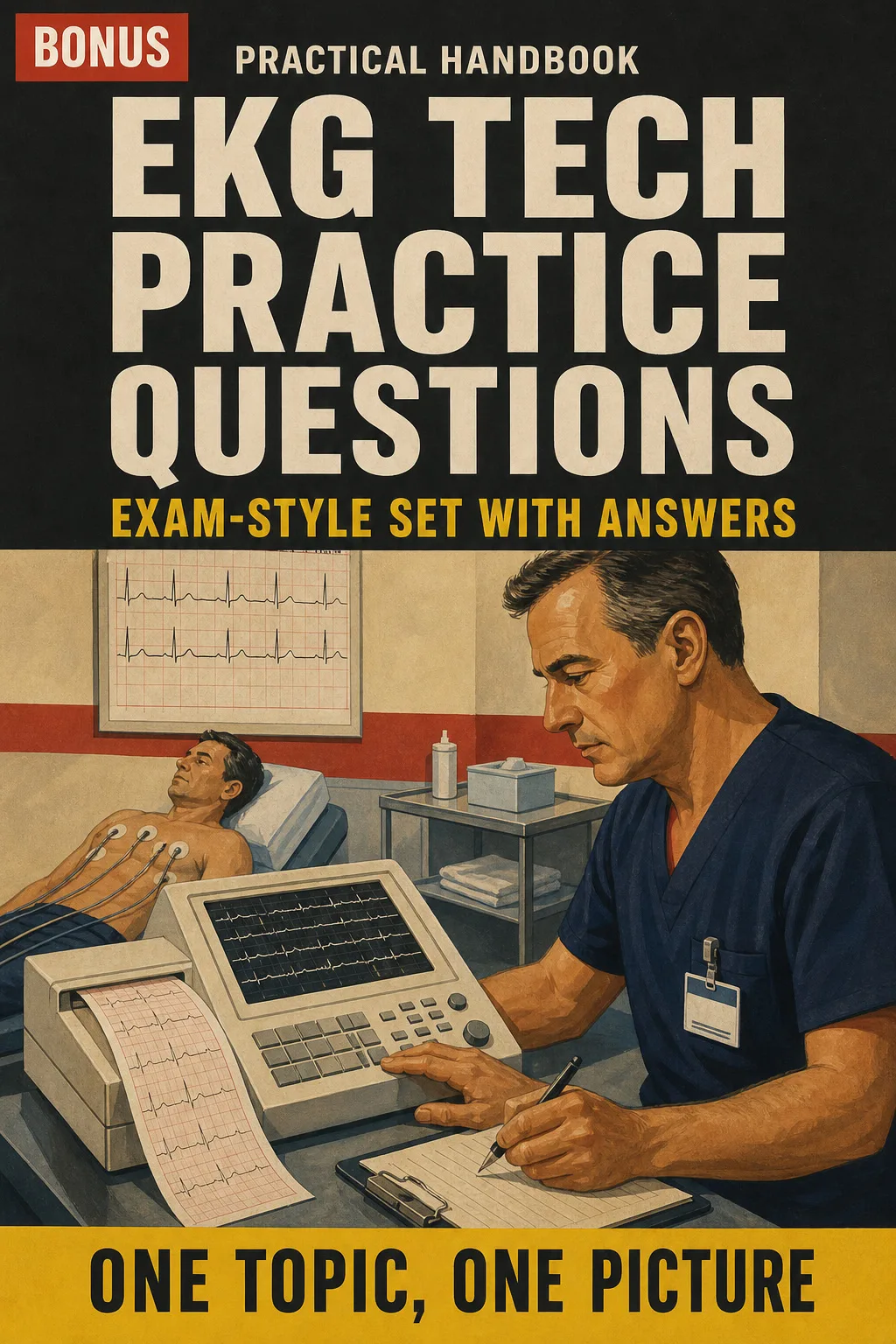
EKG Tech Practice Questions: Exam-Style Set with Answers

BONUS 1: «EKG Tech Practice Questions: Exam-Style Set with Answers»

Value on its own: US$ 17.90

Practice the kinds of questions the exam asks, then check every answer with a short explanation that sends you back to the right page.

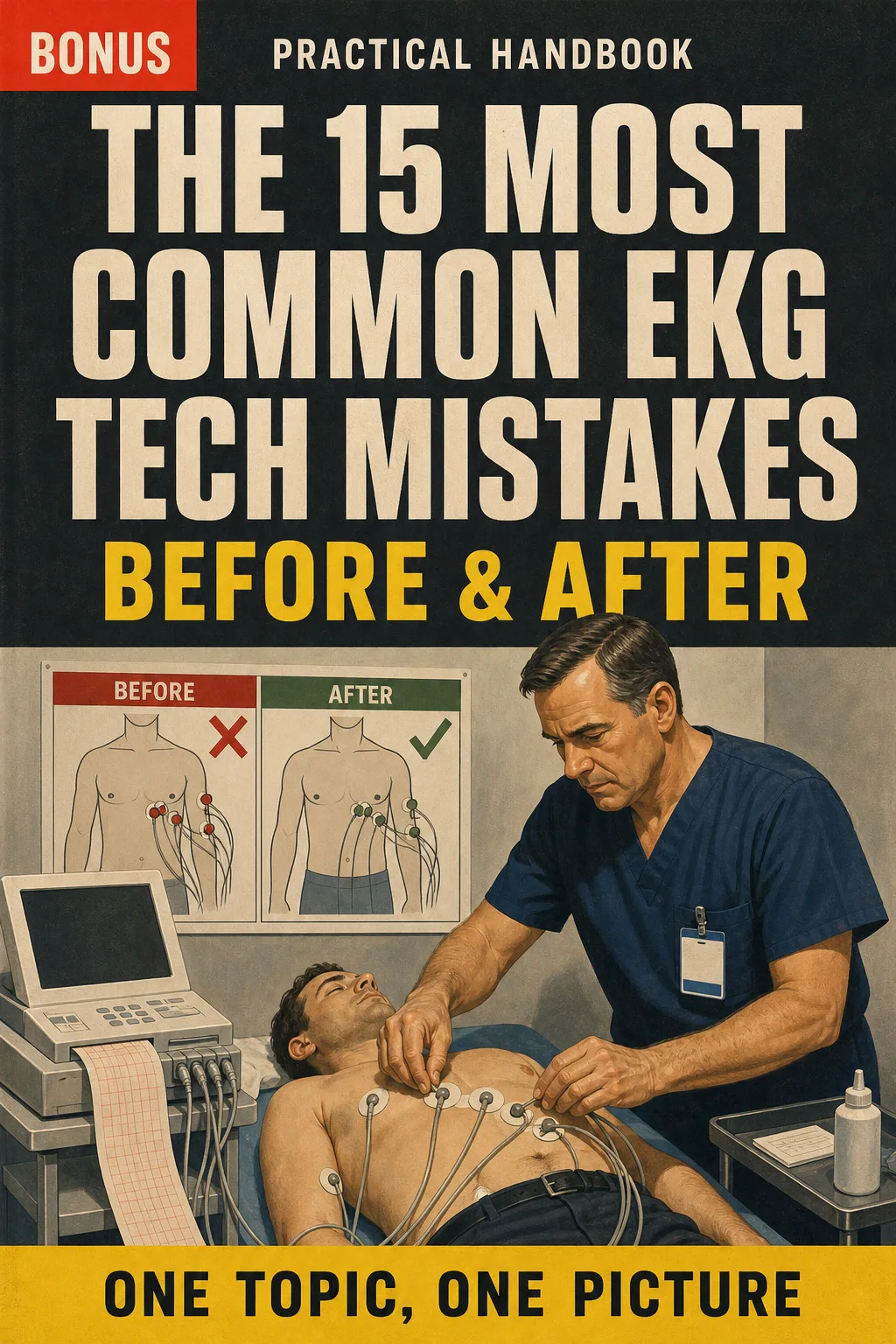
The 15 Most Common EKG Tech Mistakes: Before & After

BONUS 2: «The 15 Most Common EKG Tech Mistakes: Before & After»

Value on its own: US$ 14.90

See the slips that trip people up most often, from switched limb leads to calling an artifact a rhythm, each one drawn wrong and right on the same page.

EKG Technician Exam Illustrated with 2 Free Books

  • EKG Technician Exam Illustrated: 66 illustrated pagesUS$ 87
  • BONUS 1: EKG Tech Practice Questions: Exam-Style Set with AnswersUS$ 17.90
  • BONUS 2: The 15 Most Common EKG Tech Mistakes: Before & AfterUS$ 14.90
  • High-resolution PDF to printIncluded
Total value US$ 119.80
YOUR PRICE:
US$ 37
You save US$ 82.80
YES, I WANT EKG TECHNICIAN EXAM ILLUSTRATED FOR US$ 37

📄 This is a digital PDF book sent to your email: nothing is printed or shipped.

Secure purchaseEncrypted payment30-day guarantee

PDF by email: We email you EKG Technician Exam Illustrated as a PDF, together with the two free books. It's a single payment: no installments, no extra charges.

Who This Book Is For

You're in an EKG program

You're in an EKG program

Class covers forty rhythms fast. The book gives each one its own page, drawn on the same grid next to normal sinus rhythm, so you can review at night after work.

Your exam date is coming

Your exam date is coming

The exam-day review puts every rhythm, the key numbers and the 12-lead checklist in a few pages you can go over at a glance.

You already run EKGs on the floor

You already run EKGs on the floor

Limb colors, V1 to V6 landmarks and the artifact checks are drawn and printable, so you can keep them handy on your shift.

Everything You Get Today

US$ 119.80US$ 37
YES, I WANT EKG TECHNICIAN EXAM ILLUSTRATED FOR US$ 37

📄 This is a digital PDF book sent to your email: nothing is printed or shipped.

30DAYS
GUARANTEE

30-Day Guarantee

Try EKG Technician Exam Illustrated for 30 days, bonus books included.

We refund everything if the file won't open, if the book isn't what you see here, if you were charged twice or if the email doesn't arrive. Just email us.

You pay once. No subscriptions.

Frequently Asked Questions

Is this for me if I'm a CNA, PCT or medical assistant, not a nurse?

Yes. It's written for CNAs, patient care techs, medical assistants, hospital staff and EKG program students. It starts with the heart's wiring and explains every term, so you don't need a nursing background.

Where does the content come from?

It follows the current test plan for the NHA Certified EKG Technician (CET) exam and current American Heart Association references on lead placement and rhythm recognition, with US limb colors and US conventions. If you're taking a different EKG technician certification, the core topics (leads, limb colors, artifacts, rate and rhythms) are the same, but check them against your exam's own outline.

Is this official material?

No. It's an independent study book. It isn't affiliated with or endorsed by any certification body, and it doesn't give you a certificate or continuing education credits: your certification comes only from the exam itself. The exam and the references are named only to describe what the book covers.

Does it replace my training program?

No. It's for studying and review. It doesn't replace your training program, your clinical hours, clinical judgment or your facility's protocols.

Are the practice questions the ones on the exam?

No. They're written for this book in an exam style, and every answer sends you back to the page that explains it.

When and how do I get it?

The book and the 2 bonus books arrive as PDFs by email, sent to the address you enter at checkout.

Do I have to pay every month?

No. It's a one-time payment, with no subscription.

Can I have it on paper?

Yes. You can print the whole PDF at home or at a print shop, or just the pages you need on your shift, like the limb colors or the 12-lead checklist.

How does the refund work?

You have 30 days. We refund everything if the file won't open, if the book isn't what you see on this page, if you were charged twice or if the email doesn't arrive: just email us.

Before You Close This Page

No more rereading chapters that don't stick.

V1 to V6 and the limb colors: you see them drawn and you've got them.

You walk into the exam knowing where everything is.

Drawings make studying faster.

The book is right below.

One-time payment: US$ 37 · Guarantee: 30 days · PDF by email

YES, I WANT EKG TECHNICIAN EXAM ILLUSTRATED FOR US$ 37

📄 This is a digital PDF book sent to your email: nothing is printed or shipped.